
A Practical Guide for Families and Executors
Someone you loved collected sports cards. Now those cards are yours to deal with, and you probably have no idea where to start.
That is not a criticism. Most people who inherit a sports card collection are not collectors themselves. They are family members, executors, or trustees who are already managing a difficult process and now have a room full of binders, boxes, and plastic cases they do not fully understand. The hobby has its own language, its own pricing systems, and its own set of pitfalls that are easy to stumble into without guidance.
This guide will walk you through exactly what to do, in order. The goal is to make sure you handle the collection in a way that protects its value and gives you the information you need to make a good decision about what happens next.
First: Do Not Throw Anything Away
This sounds obvious, but it is the single most important thing to understand before you do anything else.
Sports cards from certain eras look unremarkable to someone who does not collect. They are small, often worn, sometimes stored loosely in a shoebox or rubber-banded together. A stack of cards from the 1950s or earlier can look like a pile of old paper. It might be worth a few dollars. It might be worth tens of thousands of dollars. You cannot tell from looking at it casually, and neither can most people outside the hobby.
Every year, genuinely valuable collections are partially or entirely discarded by families who assumed old meant worthless, or who kept the cards in protective holders and threw away the loose ones. Do not make that mistake. Set everything aside until you have had a chance to properly assess what is there.
This includes:
- Loose cards stored in shoeboxes or paper bags
- Cards rubber-banded together or wrapped in paper
- Old wax packs, unopened boxes, or sealed cases
- Cards in plastic sleeves, binders, or pages
- Cards in hard plastic holders or graded slabs
- Anything that looks like a complete set in a box
If you are not sure whether something is part of the collection, keep it. Sorting happens later. Right now, nothing leaves.
Step 1: Do a Basic Inventory Before You Talk to Anyone
You do not need to catalog every card in the collection before reaching out to a buyer. But you do need a general sense of what you are working with. This protects you and allows a buyer to give you a more accurate initial assessment.
Look for these things first
Start by separating the collection into rough categories. You do not need to identify every card. You need to answer a few basic questions.
How old are the cards? Cards produced before 1970 are generally considered vintage. Cards produced before 1941 are pre-war, and they require particular attention because they carry significant collector demand even in worn condition. If cards look genuinely old, with rounded corners, off-white or yellowed card stock, and printed images rather than photographs, you may be looking at pre-war material. Do not dismiss these.
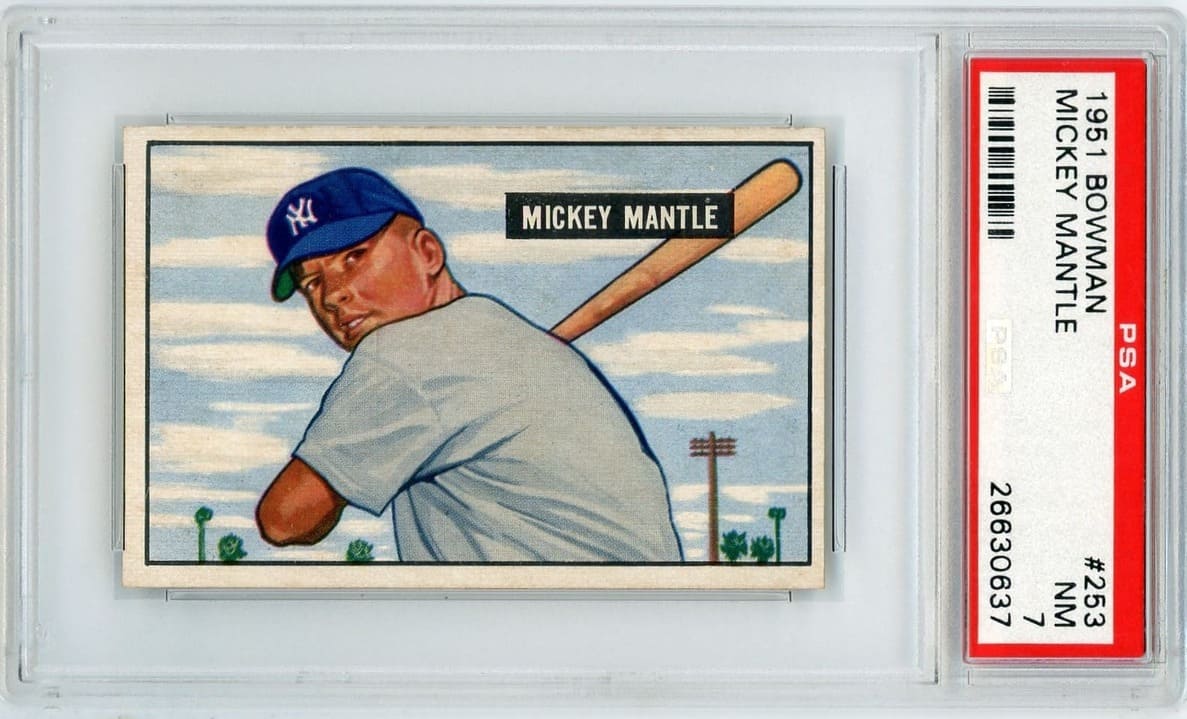
Are any cards professionally graded? Graded cards are encased in a hard plastic holder, sometimes called a slab, with a label showing the grading company (PSA, BGS, or SGC are the major ones) and a numerical grade from 1 to 10. These cards have been authenticated and assessed by a third party. A graded card in a high grade can be worth multiples of the same card raw. Make note of any graded cards and set them aside.
Are there any sealed boxes or packs? Unopened wax boxes, factory sets, and sealed cases can carry significant value, sometimes more than the individual cards inside them. Do not open them. An unopened 1986 Fleer Basketball box or a sealed 1952 Topps series pack is worth considerably more intact than opened. If you find sealed product, photograph it and keep it separate.
Are there complete sets? Complete sets stored in original boxes are often worth more than the same cards sold individually. Look for anything labeled as a complete set or stored in a way that suggests organization by year or series.
Photograph the collection before it goes anywhere
Before you show the collection to any buyer, take photographs. Photograph binders open to show the cards inside. Photograph graded slabs clearly enough to read the label. Photograph sealed boxes from multiple angles. Photograph any loose cards that look old or significant.
This creates a record of what was in the collection and in what condition. If there is ever a question about what was included or what condition something was in, you have documentation. This is basic protection for yourself, regardless of how trustworthy the buyer is.
Step 2: Understand What You Are Likely Holding
Most inherited collections fall into one of a few categories. Knowing which one you are dealing with helps you calibrate expectations before you start getting offers.
The vintage collector’s collection
If the person who built this collection was serious about the hobby, particularly if they collected before 1980, you may be looking at genuinely significant material. Collectors who were active in the 1950s, 60s, and 70s often accumulated cards that are now quite scarce. Key players from that era, Hall of Famers, rookie cards, and regional issues can carry real value even in average condition.
Pre-war cards from sets like T206, Goudey, Play Ball, and Bowman 1948 through 1952 are among the most sought-after cards in the hobby. A collection built around this era deserves careful attention before any selling decision is made.
The junk wax era collection
If the collection is heavy on cards from roughly 1986 through 1994, you are likely looking at what the hobby calls the junk wax era. Card companies massively overproduced during this period. Donruss, Fleer, Topps, and Score printed cards in quantities that far exceeded collector demand, and those cards never became scarce. Most junk wax era cards are worth very little individually, regardless of the player on the front.
There are exceptions. Rookie cards of players who went on to become Hall of Famers from this era can carry value. A 1989 Upper Deck Ken Griffey Jr. rookie is legitimately collectible. A 1991 Topps complete set of 792 cards is not worth much. Know the difference before you assume the whole collection is either valuable or worthless.
The modern collector’s collection
Collections built in the last 15 to 20 years tend to be focused on specific players, specific rookie cards, or graded material. Modern collections can include high-value cards, particularly graded rookie cards of current stars, autographed cards, and numbered parallels with print runs of 25 or fewer copies.
Modern collections require a different kind of assessment than vintage. Value is concentrated in specific cards rather than distributed across an era or set. A buyer who specializes in this area can identify what matters quickly.
The mixed collection
Most inherited collections are a mix of everything. Decades of accumulation across sports, eras, and formats. These are the most time-consuming to assess but also the ones most likely to contain hidden value that an untrained eye would overlook. Go slowly.
Step 3: Approach Selling the Right Way
Once you have a basic sense of what you have, you are ready to start thinking about selling. Here is how to approach it.
Find a buyer who specializes in what you have
Not every card buyer is the right buyer for every collection. A buyer focused on vintage and pre-war material will make a stronger offer on a 1940s collection than a buyer who primarily handles modern product. Match the buyer to the collection. A quick look at what they advertise buying tells you a lot about where their expertise and interest lies.
Be transparent about what you know and what you do not
You do not need to pretend to know more than you do. A legitimate buyer will not take advantage of your lack of knowledge. Tell them you inherited the collection, that you are not a collector yourself, and that you are trying to understand what you have before making any decisions. A buyer worth working with will walk you through their assessment process rather than rushing you toward a number.
Do not feel pressure to sell everything at once
If a buyer is interested in the whole collection but you are uncertain about specific pieces, it is reasonable to ask about selling in parts or to request time to get a second opinion on the high-value items. A legitimate buyer understands that estate situations require care. If a buyer pushes hard against you getting a second opinion, that is a signal worth paying attention to.
Understand what a fair offer looks like
Dealers buy at wholesale, not retail. An offer of 50 to 70 cents on the dollar for a strong collection is not unfair. It reflects the dealer’s need to resell the cards and make a margin. What matters is that the offer is based on an accurate assessment of what is there and that the buyer is transparent about how they arrived at the number.
An offer made without a real review of the collection is not a serious offer. Any buyer willing to make a number before they have seen the cards is anchoring low on purpose. A legitimate offer comes after a thorough look.
A Note on Estate and Executor Situations
If you are handling a collection as part of an estate, there are a few additional things worth knowing.
For estate purposes, you may need a documented valuation of the collection. This is different from a purchase offer. A purchase offer reflects what a buyer will pay at wholesale. A valuation for estate purposes reflects fair market retail value. Not every buyer provides formal appraisals, and those who do typically charge for them. If you need documentation for probate or tax purposes, clarify this upfront with any buyer you speak to.
If the estate involves multiple heirs, make sure everyone with a stake in the collection is aligned on the selling decision before you commit to anything. Disputes over inherited collections are more common than people expect, particularly when one heir believes the collection is worth more than others do.
Keep records of every offer you receive, who you spoke to, and what the offer covered. This protects you if questions arise later about how the collection was handled.
When to Get More Than One Opinion
For collections where the stakes are meaningful, getting more than one offer is worth the time. Here is a rough guide.
- If the collection appears to contain pre-war or early vintage material, get at least two opinions from buyers who specialize in that era.
- If there are graded cards with high grades (PSA 7 or above) on significant players, get comps from eBay sold listings before accepting any offer.
- If the collection is large, meaning multiple binders, several boxes, or a room full of material, the aggregate value warrants the extra step.
- If you have any reason to believe the collection may be worth more than an initial offer suggests, trust that instinct and get a second look.
Getting a second opinion does not insult a buyer. A buyer who responds badly to that request is telling you something about how they operate.
What to Expect When You Reach Out to a Buyer
When you contact a buying service like Hometown Sports Fan, here is what the process typically looks like.
You will be asked to provide basic information about the collection: an overview of what you have, photographs of key cards or graded material, and a sense of the volume. You do not need to have all of this perfectly organized. A good buyer will help you figure out what they need to see.
From there, the buyer will review what you have sent and come back with either an offer or follow-up questions. For larger collections, an in-person evaluation may be arranged. For smaller collections that can be safely shipped, a prepaid shipping label may be provided.
No legitimate buyer will pressure you to accept an offer on the spot. Take the time you need. Ask questions. If something does not feel right, it probably is not.
Final Thoughts
Inheriting a sports card collection is unexpectedly common, and the process of handling it well is not intuitive if you are not already part of the hobby. The most important things to remember are simple: do not discard anything before it has been assessed, take photographs before the collection leaves your hands, and work with buyers who are transparent about how they arrive at their offers.
The collection you inherited was built by someone who cared about it. Taking a little time to handle it properly is the right way to honor that, and it is almost always worth it financially as well.
At Hometown Sports Fan, we work regularly with families and executors handling inherited collections. We buy vintage sports cards, pre-war baseball cards, sealed product, large collections, and dealer lots. We travel within a 350 to 400 mile radius of Columbus, Ohio for significant collections and can arrange prepaid shipping for smaller lots.
There is no pressure and no obligation. If you have a collection you are trying to figure out, reach out and we will help you understand what you have.