
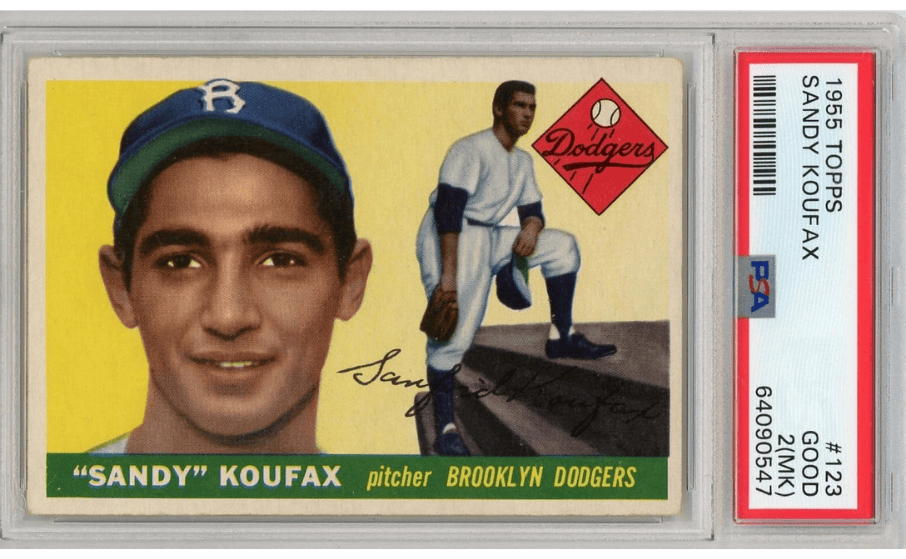
Someone in your family collected baseball cards in the 1950s or 1960s. Those cards are now yours, sitting in shoeboxes or binders, and you are trying to figure out what you have.
This is one of the most common situations we encounter as vintage card buyers. Collections from this era, the golden age of the Topps and Bowman sets, can contain cards worth hundreds or thousands of dollars each. Most people holding them do not know what to look for. This guide changes that.
Why This Era Matters
Bowman entered the market in 1948 and produced cards through 1955. Topps began in 1951 and by 1952 had established the format that defined the hobby for decades. The competition between the two companies during the early 1950s produced multiple overlapping sets, which is why you sometimes see two different cards of Mickey Mantle from the same year.
Cards from this era survived in far smaller numbers than their production quantities might suggest. These were children’s collectibles. Rubber-banded, stuffed in pockets, clipped to bicycle spokes, and handled constantly. Finding examples in strong condition today is genuinely difficult. Collector demand has grown steadily over the past 20 years and shows no sign of slowing.
How to Figure Out What Year Your Cards Are From
Most 1950s and 1960s baseball cards do not have the year printed on the front. Date them from the back.
Find the statistics section on the back. Topps and Bowman cards show a player’s season-by-season stats. Find the most recent year in the stats. The card was produced the following year. A card showing stats through 1957 was produced in 1958. That single step dates the card.
Card size also helps. Bowman cards from 1948 and 1949 are small, approximately 2-1/16 by 2-1/2 inches. Topps standardized at 2-1/2 by 3-1/2 inches with the 1957 set, which is the modern card size still used today.
The Key Sets to Know
1948 and 1949 Bowman
Bowman’s first two sets launched the post-war card hobby. The 1948 set is black and white. The 1949 set introduced color. Both are genuinely scarce in high grade. The 1948 Bowman Jackie Robinson is one of the most historically significant cards in the hobby.
1951 and 1952 Topps
Topps entered the market in 1951 with two series that look unlike anything they produced later: a Red Back and Blue Back set, plus a game-style insert. These are frequently misidentified by sellers. The 1952 Topps set is the crown jewel of the era, featuring the Mantle card at number 311 in the high-number series.
1953 and 1954 Topps and Bowman
Both companies produced overlapping sets. The 1953 Topps set features artwork-style portraits. Key 1954 cards include the Hank Aaron rookie (number 128) and the Ernie Banks rookie (number 94), both significant and valuable.
1955 Topps
The 1955 Topps set introduced a horizontal design. The Roberto Clemente rookie card (number 164) appears here and regularly sells for thousands of dollars even in modest condition.
1956 and 1957 Topps
The 1957 set introduced the modern card size. Key cards include the Brooks Robinson rookie (number 328) and Sandy Koufax (number 302).
1960s Topps
Critical rookie cards from this decade include the 1963 Pete Rose (number 537), the 1965 Joe Morgan (number 16), and the 1968 Nolan Ryan (number 177). The Ryan has been one of the most consistently valued cards from this decade.
What Makes a Specific Card Valuable
Hall of Fame rookies
A player’s first major-league card is typically their most valuable. If the player went on to a Hall of Fame career, that rookie can be worth multiples of their other cards from the same era. A buyer who knows this era can identify rookies immediately.
High-number cards
Topps produced sets in series. The final series each year, the highest card numbers, was printed in smaller quantities because retailers had already stocked the earlier series and demand had softened by late summer. High-number cards are significantly scarcer and carry premiums accordingly. Many collections from this era are missing the high numbers entirely because they were simply harder to find.
Condition
The gap between a PSA 5 and a PSA 8 on a key Hall of Famer from this era can be a factor of ten in realized value. Be realistic. Do not assume age equals quality.
Regional and food issues
Wilson Franks, Hunter’s Wieners, Briggs Meats, Dan-Dee Potato Chips, and Post Cereal all produced cards distributed in limited geographic areas during the 1950s and 1960s. These survive in far smaller numbers than the main Topps sets. If your collection includes cards with food brand backs or designs that do not match standard Topps, flag them for individual assessment.
How to Use the Card Number to Identify What You Have
Once you have dated a card to a specific year, the card number on the back is your most useful tool. Every Topps and Bowman set has an official checklist mapping every card number to the player it depicts. Those checklists are freely available at Trading Card Database (tcdb.com) and Baseball Reference.
Cross-reference your card numbers against the checklist for that year. This tells you immediately which players you have, whether any are rookie cards, and whether any fall in the high-number range where scarcity premiums apply. A collection that looks like a jumble of unfamiliar faces becomes a mapped inventory in under an hour.
Pay particular attention to cards numbered above 400 in sets from the 1950s and early 1960s. Those high-series cards are the most likely place to find hidden value in a collection that has been sitting untouched for decades.
Once you know what you have by name and number, checking eBay sold listings filtered by comparable condition gives you a real market baseline before any conversation with a buyer.
Photograph front and back before anything leaves your hands. The back dates the card and reveals regional or food issue variations a buyer needs to see.
Do not clean, press, or rubber-band the cards. Anything that alters the surface or structure reduces value and can affect gradability.
Find a buyer who knows this era specifically. A generalist may overlook high-number scarcities or regional issues that a specialist would recognize immediately.
At Hometown Sports Fan, vintage baseball cards from the 1950s and 1960s are among our primary focus. We travel within a 350 to 400 mile radius of Columbus, Ohio for significant collections and offer prepaid shipping for smaller lots. If you think you have vintage material from this era, reach out.