
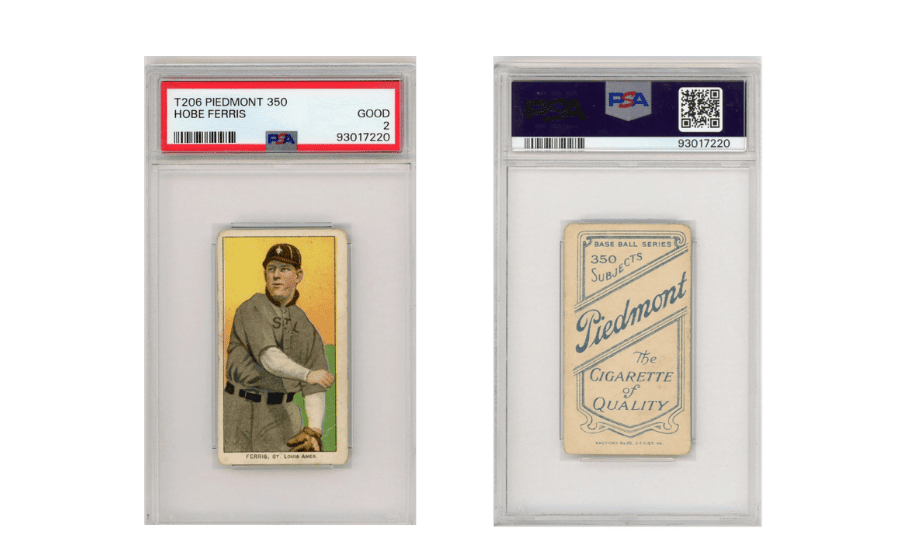
If you have old baseball cards and someone told you they might be tobacco cards, you are probably sitting on something worth a real conversation with a buyer. The T206 set, produced between 1909 and 1911 and distributed inside cigarette packs from the American Tobacco Company, is the most collected and most studied pre-war set in the hobby. It is also one of the most misunderstood by sellers who did not grow up in the hobby.
What Are T206 Cards?
T206 is the collector designation for a set of baseball cards produced from 1909 through 1911. The cards were printed in enormous variety: 524 different subjects across 16 tobacco back variations, featuring players from both leagues. They were included as inserts in cigarette packs from brands including Sweet Caporal, Piedmont, Old Mill, Polar Bear, Hindu, and about a dozen others.
The cards measure approximately 1-1/2 by 2-5/8 inches. The front features a color lithograph portrait or action pose. The back identifies the tobacco brand and includes a printed advertisement. The paper stock is thin, meaning most surviving examples show significant wear. That is expected. It does not disqualify them from collector interest.
The set is famous primarily because of the T206 Honus Wagner, which has sold multiple times for over three million dollars. But the Wagner is an extreme outlier. The vast majority of T206 cards are commons and Hall of Famers that trade in a much more accessible range, and even modest examples have genuine collector demand.
How to Identify a T206 Card
Physical characteristics
T206 cards are small, roughly the size of a large postage stamp. The image is a color lithograph, not a photograph, giving it a slightly painterly quality. Borders are white. Player name and team appear at the bottom.
The back is the most definitive identifier. T206 backs feature the name of a tobacco brand, the American Tobacco Company logo, and a printed advertisement. Common backs include Piedmont (the most frequently found), Sweet Caporal, Old Mill, Sovereign, Cycle, Hindu, and Polar Bear.
What T206 cards are not
T206 cards are frequently confused with other pre-war sets. T205 cards (Gold Borders, 1911) are slightly different in design. T207 cards (1912) have a brown border. E90-1 American Caramel cards look similar but came with candy rather than tobacco. All of these sets carry collector value. A buyer who specializes in this era can identify them quickly.
What Drives T206 Value
Player
Hall of Famers carry the most demand. In rough order of collector interest: Honus Wagner, Eddie Plank, Joe Doyle (specific error variations), Ty Cobb, Christy Mathewson, Walter Johnson, Cy Young, Nap Lajoie, and Tris Speaker. Cards of these players in any condition are worth meaningful money and deserve individual attention before any selling decision. Common players still sell for $40 to $100+ in average condition. There are very few T206 cards that are completely without value.
Back variation
The back tells collectors which tobacco brand packaged the card, which reflects that print run’s relative scarcity. Piedmont and Sweet Caporal backs are the most common. Hindu, Polar Bear, and Drum backs are among the scarcest. Premiums range from 2x all the way to 40x the base card value depending on the specific back and player. Most sellers have no idea their backs matter. They matter enormously. Photograph the back before any card leaves your hands.
Condition
Cards over 110 years old rarely survive in pristine condition. But even low-grade T206 cards in Poor or Fair condition have real collector demand because of the set’s historical significance. The age and scarcity override the condition penalty that applies to modern material.
Known rarities and errors
The T206 Joe Doyle error (reads ‘N.Y. Nat’l’ instead of ‘N.Y. Amer’l’), the T206 Eddie Plank, and several scarce back variations carry premiums well beyond face value. If your collection includes these subjects, they need individual assessment before the collection is priced as a whole.
Realistic Value Ranges for T206 Cards
These reflect current raw market transactions. The T206 market has strengthened significantly in recent years. Older price references circulating online are frequently outdated by a wide margin.
Common player, common back, Poor to Good: $40 to $100+. Untrimmed T206 commons in heavily beaten condition rarely sell for less than $40 today. A PSA 1 common frequently clears $50 to $70.
Common player, common back, VG to Excellent: $120 to $300+. Clean raw examples with strong eye appeal that would grade VG 3 or VG-EX 4 now command $120 to $250 at minimum.
Hall of Famer, common back, Poor to Good: $250 to $800+. Lower-tier HOFers like Rube Marquard can be found near $150 in poor condition. Icons like Cy Young, Christy Mathewson, and Walter Johnson start closer to $400 to $800 even with heavy creases.
Hall of Famer, common back, VG to Excellent: $800 to several thousand. Mid-grade examples of major names easily cross four figures.
Scarce back (Hindu, Polar Bear, Drum): A Polar Bear back might carry a 1.5x to 2x premium. A Hindu or Drum back changes the conversation entirely. A $50 Piedmont-back card can become a $2,000 to $4,000 card on a Drum back.
Ty Cobb, any condition, any back: $1,500 to $2,500+ for raw or damaged examples. Any authentic, unaltered Cobb in poor condition starts well north of $2,000. His cards appear in four poses, each with different value. Do not accept a Cobb offer without a second opinion from a pre-war specialist.
These are market guidelines, not appraisals. The only way to know what your specific cards are worth is to have a buyer who knows the set review them individually.
What to Do Before You Sell
Photograph front and back of every card
Non-negotiable. The back variation is as important as the front. Photograph in good natural light, flat against a neutral background, with enough resolution to read the text. Do this before any card leaves your possession.
Do not clean or press the cards
Collectors and graders can detect cleaning, pressing, and surface manipulation. Attempting to improve a card’s appearance almost always reduces its value and can disqualify it from grading. Leave the cards exactly as you found them.
Keep the collection together until it has been assessed
Collections of T206 cards are often worth more together than broken up, particularly if they represent a meaningful portion of the set or include multiple Hall of Famers. Get a complete picture before making any decisions.
Find a buyer who knows the set
General card buyers may not know T206 well enough to make accurate offers, particularly on scarce backs or condition-sensitive Hall of Famers. A fair offer accounts for the player, the back, the condition, and current market demand. Not just a quick scan of the front.
At Hometown Sports Fan, pre-war baseball cards including T206, T205, Goudey, Play Ball, and related sets are among the material we focus on most. We travel within a 350 to 400 mile radius of Columbus, Ohio and offer prepaid shipping for smaller lots. If you have T206 cards or other pre-war material, reach out.